Home »
Jazz Articles » Music and the Creative Spirit » Unfiltered – Ben Jaffe at Preservation Hall, New Orleans
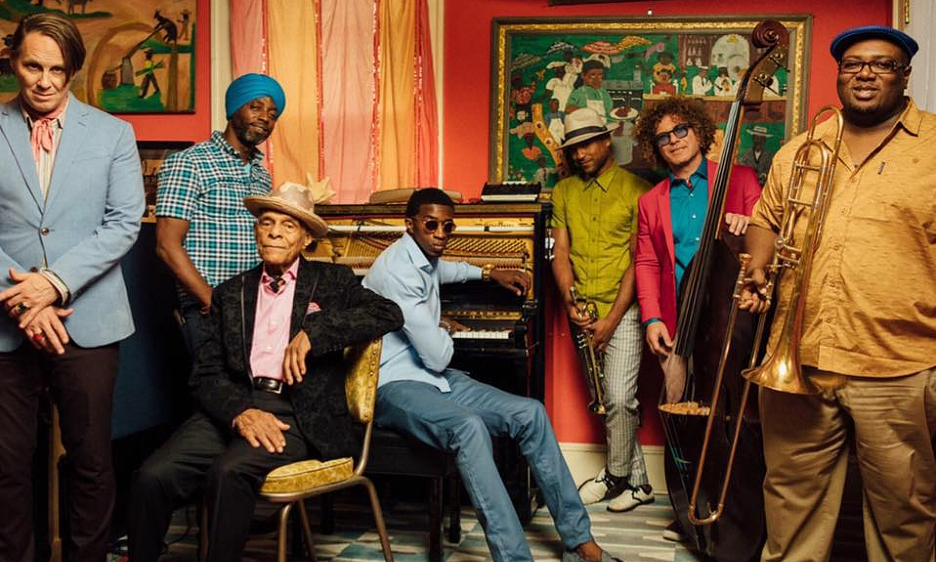
Courtesy Preservation Hall Website
In the Moment, a yet-to-be-published interview put together for a New Orleans music magazine with

”
data-original-title=”” title=””>Ben Jaffe, creative director of Preservation Hall, was actually the distillation of a conversation rather than a mere moment in time. Nor was it an interview in the dictionary sense of that word; for the most part, the Q and A format was absent. Prepared with a list of maybe fifty questions, fewer than 10 were ever asked.
Shy to request two hours (I did, though, just in case), we hooked up for a three-hour-long, at times deeply personal, conversation. Jaffe spoke, recalling what it was like to grow up at Preservation Hall. Often, with a dreamy, far-off look in his eyes partially shaded by his trademark smoky lenses, he recalled his unique upbringing in a nurturing artistic environment of Preservation Hall, an institution founded by his parents in 1961 in the heart of the French Quarter. Living and working in rather open defiance of the New Orleans ‘mingling statute’ in the segregated South of the early ’60s, his parents befriended legendary figures in the history of jazz in New Orleans and all of North America too.
The story about the Hall, as recounted on its website, implies that civil rights was merely a by-product of organizing a place for African-American jazz players to revisit their artistry and resume lost careers. That is the official account.
But according to Jaffe, the initial founding of the Hall was not only about his parents’ love for the music but was also politically motivated. Most Jews of that generation were quite vocal in their support of Blacks in their demand for civil rights. Political activism and love of the music together were the impetus to establish what is now a time-honored institution in this city, once the primary port for ships to unload and sell their human cargo in slave markets adjacent to the French Quarter. In response to a direct question if championing civil rights was on his parents’ minds when they established the Hall, his response”Definitely!.” He readily volunteered more, requiring no further prodding.
“They also knew that being Jewish in the South could get you killed. They knew what they were doing while organizing these openly integrated music sessions celebrating African-American music. And they understood it had the potential to get ‘rowdy,’ at least that’s how the mainstream mindset at that time might have responded to what they were doing. My father supported what Dr. Martin Luther King represented, and understood there were many who failed to appreciate the image of a dignified black man wearing a suit, along with a pressed white shirt and tie, orating with poetic eloquence about social injustices.
“They understood the inherent dangers too as, after all, the same summer my parents moved to New Orleans, three college students disappeared in Mississippi. None of that was lost on them or, subsequently, on me either.
“I attended a college with activists where, if you’re paying attention, there are moments in time when you feel the energy, the pull of certain movements. There was a pull felt by

Pete Seeger
banjo
1919 – 2014