Home »
Jazz Articles » Album Review » Bram De Looze, Felix Henkelhausen, Eric McPherson: Vice …

Belgian pianist Bram De Looze’s Vice Versa project is one that gradually becomes visible, the way a constellation appears only after your eyes adjust to the night. The music feels as if it had always been orbiting somewhere just beyond earshot, waiting for the right trio of creatives to call it into being.
At the center of it all, De Looze’s playing carries a sensitivity to hidden paths. Reaching outward across cities and oceans, he did not recruit sidemen but encountered kindred voyagers. New York drummer

”
data-original-title=”” title=””>Eric McPherson brings a gravity that never weighs the music down, while Berlin-based bassist
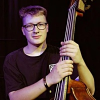
Felix Henkelhausen
bass, acoustic
”
data-original-title=”” title=””>Felix Henkelhausen provides a foundation that feels more like an undercurrent than a floor. Together they form a triad held in place not by agreement but by attraction, a musical Venn diagram where three distinct worlds overlap and generate a fourth.
After their celebrated 2023 debut, the trio returned to the acoustically luminous Studio 1 in Flagey during De Looze’s residency at the Brussels Jazz Festival. On January 16, 2025, before a sold-out crowd, they recorded this second album live. The room itself seems to breathe with them, capturing that rare moment when performance tips into something bordering on the transcendent.
The album begins with a triptych devoted to spiraling, gyroscopic rhythm, a kind of sonic carousel that keeps you spinning while somehow guiding you forward. “Popo” opens in shadowed tones that burrow downward, as if De Looze were tunneling toward a buried source of melody. The descent bears a hint of claustrophobia, yet within it pulses a stubborn lyricism, mineral-rich and strange. When McPherson and Henkelhausen enter, the music suddenly changes altitude. The groove drops in like a comet, splashing the present with a shimmer of tomorrow, and the once-constricted space lifts into something expansive, even airborne. Without warning, the music glides into “Detachment,” which circles with a jubilance that feels earned rather than easy. Its patterns interlock like a kaleidoscope built by architects with dancing shoes. Everything tilts slightly off axis, yet nothing collapses, a balancing act that tastes wild while remaining exquisitely controlled. “Thyme” closes the suite, and its title proves to be more shape than recipe. Instead of seasoning the music, the word becomes a texture, each piano key a seed, each bass string a root, each cymbal stroke a gust of wind that might scatter or nourish. De Looze fractures into multiple selves, but they share a single compass. Motifs return like familiar landmarks, though each pass changes their shape.
Henkelhausen’s “Ninetees” follows, credited as a loose interpretation rather than a strict composition. Even so, it feels like a carefully engineered building whose beams you can hear creaking in satisfying ways. The bassist attends to every internal detail, letting the piece expand while quietly ensuring that nothing leaks, cracks, or collapses.
Then comes “Rebounce,” the album’s gravitational center. Nearly twenty-one minutes long, it is less a track than a world. De Looze describes it as an attempt to make rhythm inhale and exhale, and the trio indeed achieves something close to rhythmic respiration. The piece unfolds with a clear emotional arc, beginning in shadow, wandering through twilight, and eventually stepping into a kind of musical daylight. Listening becomes an act of surrender, but a willing one, as the trio spins a narrative that never feels manipulative, only magnetic.
“Probability” closes the record by echoing the spirit of their earlier piece “Pi,” though not by imitation. Another expansive journey, it demonstrates the trio’s uncanny ability to stretch time without wasting it. Transitions occur as naturally as weather changes, groove melting into balladry, density thinning into openness, tension dissolving into a kind of interlocking bliss. Light and shadow trade places so smoothly that you forget which is which.
Taken as a whole, Rebounce feels like a living organism rather than a finished product. It is music that searches, listens back, and transforms itself in the process. By the end, it has stepped out of the proverbial frame, leaving the air humming with possibilities that have yet to be named.