Home »
Jazz Articles » Profile » Joni Jazz, Part 2
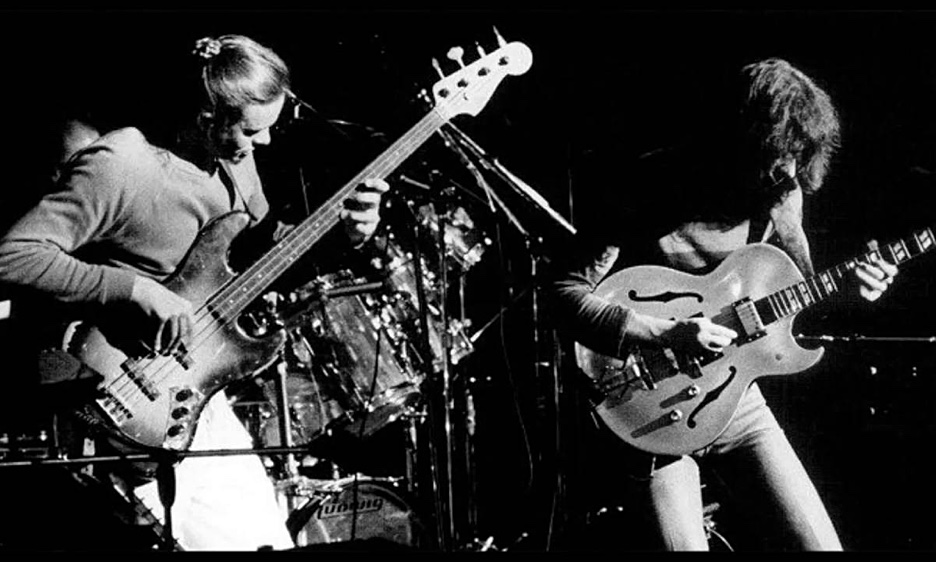
Jaco, with his musical genius and his completely original way of playing the bass,
which is
not like a bass—he plays the bass, as if he were playing an orchestra—he thinks
conceptually as an arranger, and it affected Joni’s playing.
Henry Lewy, sound engineer
”
data-original-title=”” title=””>Joni Mitchell was fond of American popular music and bought records whenever she could afford them. She would sometimes swap painting jobs for jazz albums.
Among her favorite jazz artists were

Duke Ellington
piano
1899 – 1974
”
data-original-title=”” title=””>Duke Ellington and Lambert, Hendricks and Ross. She later recorded “Twisted” by

Annie Ross
vocals
1930 – 2020
”
data-original-title=”” title=””>Annie Ross and

Wardell Gray
saxophone, tenor
1921 – 1955
”
data-original-title=”” title=””>Wardell Gray and “Centerpiece” by

Jon Hendricks
vocals
1921 – 2017
”
data-original-title=”” title=””>Jon Hendricks and

Harry “Sweets” Edison
trumpet
1915 – 1999
”
data-original-title=”” title=””>Harry “Sweets” Edison.

Miles Davis
trumpet
1926 – 1991
”
data-original-title=”” title=””>Miles Davis and his two great quintets.
“More and more I’m beginning to show what he (Miles Davis) taught mepure straight tones holding straight lines,” Mitchell said. “The feeling when you sing and you open up your heart. If you just try to remember to keep your heart open, it produces a warmer tone than if you really think you’re hot shit, because the tone is going to get cold then.”
Mitchell was moved by Davis’ rendition of Richard Rodgers‘ “It Never Entered My Mind” from Workin’ with the Miles Davis Quintet (Columbia, 1954) with Davis, pianist

Red Garland
piano
1923 – 1984
”
data-original-title=”” title=””>Red Garland, bassist

Paul Chambers
bass, acoustic
1935 – 1969
”
data-original-title=”” title=””>Paul Chambers and drummer

Philly Joe Jones
drums
1923 – 1985
”
data-original-title=”” title=””>Philly Joe Jones (saxophonist

John Coltrane
saxophone
1926 – 1967
”
data-original-title=”” title=””>John Coltrane mostly lays out).
Davis is quoted as telling pianist

”
data-original-title=”” title=””>Keith Jarrett that he stopped playing ballads because he loved ballads too much. He felt it inhibited his growth as a musician.
Mitchell also admired how Davis’ second quintet, with

Wayne Shorter
saxophone
1933 – 2023
”
data-original-title=”” title=””>Wayne Shorter on saxophone, pianist

Herbie Hancock
piano
b.1940
”
data-original-title=”” title=””>Herbie Hancock, drummer

Tony Williams
drums
1945 – 1997
”
data-original-title=”” title=””>Tony Williams and bassist

”
data-original-title=”” title=””>Ron Carter, developed a penchant for telepathically communicating and playing off one another without taking individual solos. Nefertiti (Columbia, 1967) and In a Silent Way (Columbia, 1969) were Mitchell’s favorite Miles Davis records.
“What was intended to be the initial rehearsal of “Nefertiti,” a new, 16-bar tune by Shorter, found the group repeating the melody line, over and over, tugging and pulling at the tune, embellishing it at willyet never veering off to solo over the harmony as per standard jazz practice.” milesdavis.com
Miles Davis alumni Hancock and Shorter soon became Mitchell’s frequent musical collaborators, along with a young bassist from Florida.
“When Jaco came in,” Mitchell recalled, “(drummer)
John Payne Guerin
drums
b.1939
”
data-original-title=”” title=””>John Payne Guerin said to me, ‘God, you must love this guy; he almost never plays the root!'”

Joe Zawinul
keyboards
1932 – 2007
”
data-original-title=”” title=””>Joe Zawinul, Shorter founded the seminal jazz fusion group

Weather Report
band / ensemble / orchestra
”
data-original-title=”” title=””>Weather Report in 1970.

Jaco Pastorius
bass, electric
1951 – 1987
”
data-original-title=”” title=””>Jaco Pastorius joined Weather Report on fretless electric bass in 1976.
“I have this circle of musicians. This is [what] I refer to as the circle of magicians,” Mitchell said. “Wayne Shorter, incredibly profound creative person. Jaco Pastorius is one of the great music teachers of all times, aside from just being an awesome musician and a great catalyst. He’s kicked us all into gear. He’s directly responsible for any growth that’s perceptible in me.”
Mitchell’s longtime engineer Henry Lewy added: “Because Jaco, with his musical genius and his completely original way of playing the bass, which is not like a basshe plays the bass, as if he were playing an orchestrahe thinks conceptually as an arranger, and it affected Joni’s playing. She also started doing things on the guitar and on the voice that she had never done before.” Hejira (Asylum, 1976) and Don Juan’s Reckless Daughter (Asylum, 1977) were really a big collaboration between Joni and Jaco.”
Mitchell met Pastorius after she recorded Hejira with The LA Express, and she dubbed Jaco onto four tracks. His “bass of doom” is immediately recognizable: a 1962 Fender Jazz Bass with its frets removed.
The theme of the album is physical and spiritual motion during a period of turmoil. Mitchell wrote Hejira as she crisscrossed the country during a road trip from California to Maine, down to Florida and back to California.
She didn’t have a driver’s license so she tucked in behind trucks, who would flash their lights if they saw the police. The entire album is written for guitar, since pianos were hard to come by on the road.
The title Hejira references the prophet Mohammed fleeing Mecca for Medina to escape persecution: a strategic retreat with honor. The song and journey reflect Mitchell’s state of mind following her breakup with drummer John Guerin.
Mitchell’s next release, Don Juan’s Reckless Daughter was her most experimental record. The double album is centered around “Paprika Plains,” a 16.5-minute-long orchestrated tribute to the native people of Canada.

Michael Gibbs
trombone
b.1937
”
data-original-title=”” title=””>Michael Gibbs conducted the orchestra, with Mitchell on piano.
The album title references Carlos Castaneda’s apocryphal 1968 novel, The Teachings of Don Juan.
Don Juan’s Reckless Daughter was so far ahead of its time that the public and critics didn’t know what to make of it. Writing for Rolling Stone, critic Janet Maslin stated: “[The] best that can be said” for it was that “it is an instructive failure.”
As with Duke Ellington’s orchestra in Black, Brown and Beige, when artists diverge from the popular music lane that they have been assigned, the fallout can be brutal. It didn’t help that in both instances the subject focuses on people who were oppressed by the dominant culture. The images in this video nicely complement Mitchell’s orchestrated story.
Paprika Plains
Following Don Juan’s Reckless Daughter, Mitchell was contacted by legendary bassist

Charles Mingus
bass, acoustic
1922 – 1979
”
data-original-title=”” title=””>Charles Mingus, who was dying from Lou Gehrig’s disease. Mingus wrote the music for six songs and Mitchell worked with several of his compositions, including lyrics to his tribute to

Lester Young
saxophone
1909 – 1959
”
data-original-title=”” title=””>Lester Young, “Goodbye, Pork Pie Hat.” Herbie Hancock and Wayne Shorter back Mitchell on Mingus (Asylum, 1979), along with

”
data-original-title=”” title=””>Peter Erskine on drums, Alias on congas, Pastorius on bass and

Emil Richards
percussion
1932 – 2019
”
data-original-title=”” title=””>Emil Richards on percussion. And there were wolves.
Mitchell on Miles Davis and Charles Mingus
Shadows and Light
In 1979, Mitchell took her band of fusion jazzers on a tour titled Shadows and Light, adding

Michael Brecker
saxophone, tenor
1949 – 2007
”
data-original-title=”” title=””>Michael Brecker on saxophone, guitar virtuoso

”
data-original-title=”” title=””>Pat Metheny and

Lyle Mays
keyboards
1953 – 2020
”
data-original-title=”” title=””>Lyle Mays on keyboards, along with the acapella group The Persuasions. The concert at the Santa Barbara Amphitheater in September 1979 was recorded and Shadows and Light, (Asylum, 1980) was released as an album and DVD.
In France They Kiss on Main Street
James Dean from Rebel Without a Cause (Warner Brothers, 1955) is Mitchell’s rebellious avatar.
Down and Out in Memphis, Tennessee
“Furry Sings the Blues” chronicles a trip that Mitchell took to Memphis, once a thriving musical city that had fallen into urban renewal and decay. Furry Lewis, whom Mitchell visited, didn’t much care for Joni or her song and felt she owed him royalties. Mitchell’s alter ego, Art Nouveau, makes a quick cameo appearance in the video.
Hejira
Also from the Shadows and Light concert, “Hejira” highlights some of Mitchell’s most sublime imagery and the ice dancing video foreshadows her interest in dance.
Amelia
“Amelia” is framed around the historic aviator Amelia Earhart within the context of Mitchell’s pervasive contradictions: romantic commitment versus. individual freedom and staying put versus the lure of the open road.
Goodbye Pork Pie Hat
Mitchell wrote lyrics for Mingus’ tribute to
Lester Young
saxophone
1909 – 1959
”
data-original-title=”” title=””>Lester Young
Mingus died in Mexico on Jan. 7, 1979, and never heard the finished work.
Joni and Herbie
In 1998, Mitchell’s longtime friend and collaborator Herbie Hancock released a tribute to George Gershwin titled Gershwin’s World (Verve Polygram, 1998). He asked Mitchell to sing

George Gershwin
composer / conductor
1898 – 1937
”
data-original-title=”” title=””>George Gershwin‘s “Summertime.”
River: The Joni Letters
In 2007, Hancock released an album titled River: The Joni Letters (Verve, 2007), which consisted of Mitchell songs that were sung by various vocalists, along with some others that influenced her music, including “Nefertiti.” Mitchell’s friend and fellow Canadian Leonard Cohen recites the lyrics to “The Jungle Line.”
The Making of The Joni Letters
Jazzers Herbie Hancock and Wayne Shorter welcomed Mitchell into their musical world and she reciprocated with the gift of her words.
To the surprise of virtually everyone, River won the 2008 Grammy for Album of the Year.
Presentation
Clowning Around
Joni Mitchell is a serious artist, but she also has a sense of humor. She said her mother loved this song from her album Chalk Mark in a Rain Storm (Geffen, 1988) I’m not so sure about Joni’s cat, though.
Tags
PREVIOUS / NEXT
Support All About Jazz

All About Jazz has been a pillar of jazz since 1995, championing it as an art form and, more importantly, supporting the musicians who make it. Our enduring commitment has made “AAJ” one of the most culturally important websites of its kind, read by hundreds of thousands of fans, musicians and industry figures every month.
Go Ad Free!
To maintain our platform while developing new means to foster jazz discovery and connectivity, we need your help. You can become a sustaining member for as little as $20 and in return, we’ll immediately hide those pesky ads plus provide access to future articles for a full year. This winning combination vastly improves your AAJ experience and allow us to vigorously build on the pioneering work we first started in 1995. So enjoy an ad-free AAJ experience and help us remain a positive beacon for jazz by making a donation today.